
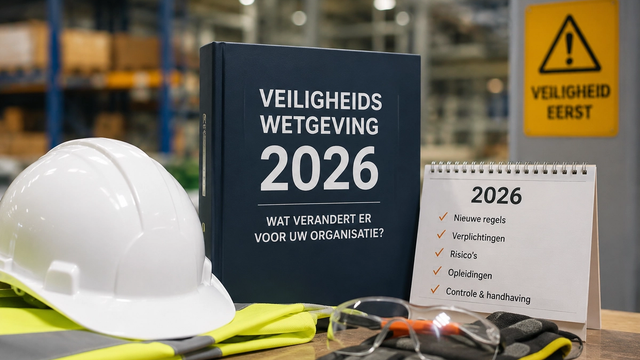
Safety legislation never stands still. In Belgium, the rules on well-being at work are regularly tightened, and 2026 is no exception. For HR managers, prevention advisors and company directors, it is therefore crucial to be aware of the latest obligations in good time. Those who fail to evolve risk not only fines or a shutdown of operations, but also — and this is the most important — workplace accidents that could have been avoided.
Code on Well-being at Work: what is new in 2026?
The Code on Well-being at Work is the central frame of reference for safety and health in the Belgian workplace. In 2026, a number of important changes take effect that directly impact your day-to-day operations.
Chemical agents and asbestos: stricter limit values
The limit values for exposure to chemical agents are being further tightened, in line with the European directives. Particular attention goes to asbestos: the permitted exposure limit is being lowered and the mandatory risk analysis is being expanded. Every employer whose workers may come into contact with asbestos fibres — think of renovation work, maintenance of older buildings or demolition activities — must have an up-to-date and documented risk analysis. If it is missing, you risk an immediate shutdown of the works.
Reintegration policy: new obligations for employers
The reintegration policy for the long-term ill is being further strengthened. Employers are now required to start a formal reintegration process for workers who are unable to work for longer than four weeks. This process must be documented and discussed with the occupational physician. A proactive approach is not only legally required here, but also in the interest of your organisation.
RD December 2025: tightening of training requirements
The Royal Decree of December 2025 introduces stricter training requirements for workers in specific risk groups. In concrete terms, this means that operators of forklifts, aerial work platforms and cranes are now required to renew their certificate within a shorter period, and that the content of the mandatory training is expanded with modules on emergency procedures and risk management. Employers who fail to comply with this can be sanctioned during an inspection visit.
Priorities of the Labour Inspectorate in 2026
The Belgian Labour Inspectorate has published a clear action plan for 2026 with an increased frequency of checks in a number of specific sectors and domains. As an employer, you would do well to know these priorities and align your internal processes accordingly.
Operators' safety certificates under scrutiny
In 2026, inspectors will pay particular attention to the validity of the safety certificates of operators who work with forklifts, aerial work platforms and cranes. The absence of a valid and recognised certificate is regarded as a serious infringement. The consequences can be severe: an official report, an immediate shutdown of operations and even criminal prosecution of the employer or the responsible manager.
Working at height and mobile equipment
Working at height remains one of the main causes of serious workplace accidents in Belgium. In 2026, the inspectorate will systematically check whether workers who work at height have the required training and whether the collective and individual protective equipment is used correctly. The use of mobile equipment — from reach trucks to telescopic handlers — is also high on the inspectors' agenda.
What does this mean for you as an employer?
The legal training obligation is not a non-binding recommendation — it is anchored in the Code on Well-being at Work (art. II.1-4) and imposes a clear responsibility on employers. You are obliged to give your workers the necessary training and instructions so that they can carry out their tasks safely. This applies in particular to high-risk activities such as operating forklifts, aerial work platforms, cranes and other work equipment.
Recognised certificates: no alternative
For a large number of high-risk activities, only recognised certificates are valid. An internal certificate or training from a non-recognised organisation is not sufficient. The recognition must be granted by the competent authorities, such as the FPS Employment (WASO) or Fedris. Employers who deploy their workers without a valid recognised certificate expose themselves to considerable risks.
Dangers of non-compliance
The consequences of non-compliance are manifold. First, there are the administrative sanctions: fines that can run up to tens of thousands of euros per infringement. Second, there is criminal liability: in the event of a serious workplace accident where a lack of training is established, the employer or the responsible manager can be prosecuted personally. Third — and perhaps the most far-reaching — there are the human consequences: a workplace accident has a lasting impact on the victim, the colleagues and the entire organisation.
How does Normec Praxis help you further?
Normec Praxis is the Belgian training centre par excellence for safety training in the workplace. With 25 official accreditations and 82 locations spread across Belgium, we are the partner that gets your organisation in order quickly and efficiently with the applicable legislation.
Fast and recognised: certificate in one day
Our training courses for forklift, aerial work platform, crane, first aid and asbestos are organised in such a way that in most cases your employees can obtain a recognised certificate in a single day. That means minimal downtime in the workplace and maximum certainty for your organisation. Our certificates are recognised by Fedris, the FPS Employment (WASO) and other competent bodies.
Tailor-made in-company training
Do you have a larger group of employees who need to be trained at the same time? Then we offer in-company training courses, entirely tailored to your sector, your equipment and your specific working environment. Our experienced instructors come to you, so that your team can practise in the familiar working environment. This increases not only the learning curve, but also the practical applicability of the training.