
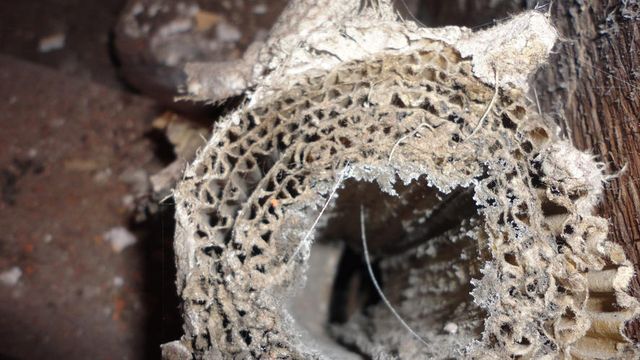
Asbestos is difficult to recognise with the naked eye. In case of doubt, it is advisable to have an analysis carried out by an accredited laboratory.
- Firmly bound asbestos
- Tar-bound or semi-firmly-bound asbestos
- Loosely bound or non-bound asbestos
Want to know which techniques exist to remove asbestos? Read it here.
What is asbestos?
Asbestos is a collective name for a group of minerals occurring in nature. The material is made up of small fibres that are not visible to the naked eye.
Asbestos was often used in the past in house building, because the substance is heat-resistant, sound-insulating, wear-resistant and easy to work with.
What are the dangers of asbestos?
Asbestos fibres that are released cause many diseases and cancers that are usually only visible 20 to 40 years after exposure.
That is why it has been forbidden since 1998 to produce asbestos-containing materials.
When is asbestos dangerous?
Asbestos is only dangerous when it is damaged or worked. The small fibres are then released and you can inhale them.
It is not dangerous to look at asbestos or to touch it. Even swallowing asbestos does not appear to be dangerous according to current insights.
What types of asbestos exist?
- Firmly bound asbestos: the fibres are firmly anchored in the material. The asbestos fibres are released with difficulty. Examples: corrugated sheets, roof slates, façade panels, flower boxes, sewers, pipes...
- Tar-bound or semi-firmly-bound asbestos: originally firmly bound asbestos, in which the binder is in poor condition due to ageing or damage.
- Loosely bound or non-bound asbestos, most dangerous: all other asbestos-containing materials. The fibres are minimally anchored in the material. The fibres come loose easily.
How to recognise asbestos?
Note: asbestos is difficult to recognise with the naked eye! In case of doubt, it is advisable to have an analysis carried out by an accredited laboratory.
- Corrugated sheets: 'AT' on the corrugated sheet means it contains asbestos. 'NT' on the corrugated sheet means it does not contain asbestos.
- The fire test: asbestos fibres do not burn. Run a flame along a fracture surface of the material. If you see that the fibres keep glowing, it is probably asbestos fibres.
Other fibres melt away or lose their structure. Note that this technique only gives an indication. For real analysis, you must consult an accredited laboratory. - Year of production: in new-build homes, asbestos is no longer used. Since 1998, asbestos has been banned in Belgium. The peak of asbestos use lies between the Second World War and the mid-1990s.
- Asbestos has a waffled texture, also called 'honeycomb'
Asbestos inventory
Employers are legally obliged to draw up an asbestos inventory before having work carried out on a building.
Asbestos training at Praxis
Need an asbestos course? Praxis is happy to arrange this for you:
- Asbestos training simple handling (8h)
- Asbestos removal course 32h
- Asbestos exposure
- Asbestos annual refresher training
19/06/2018