
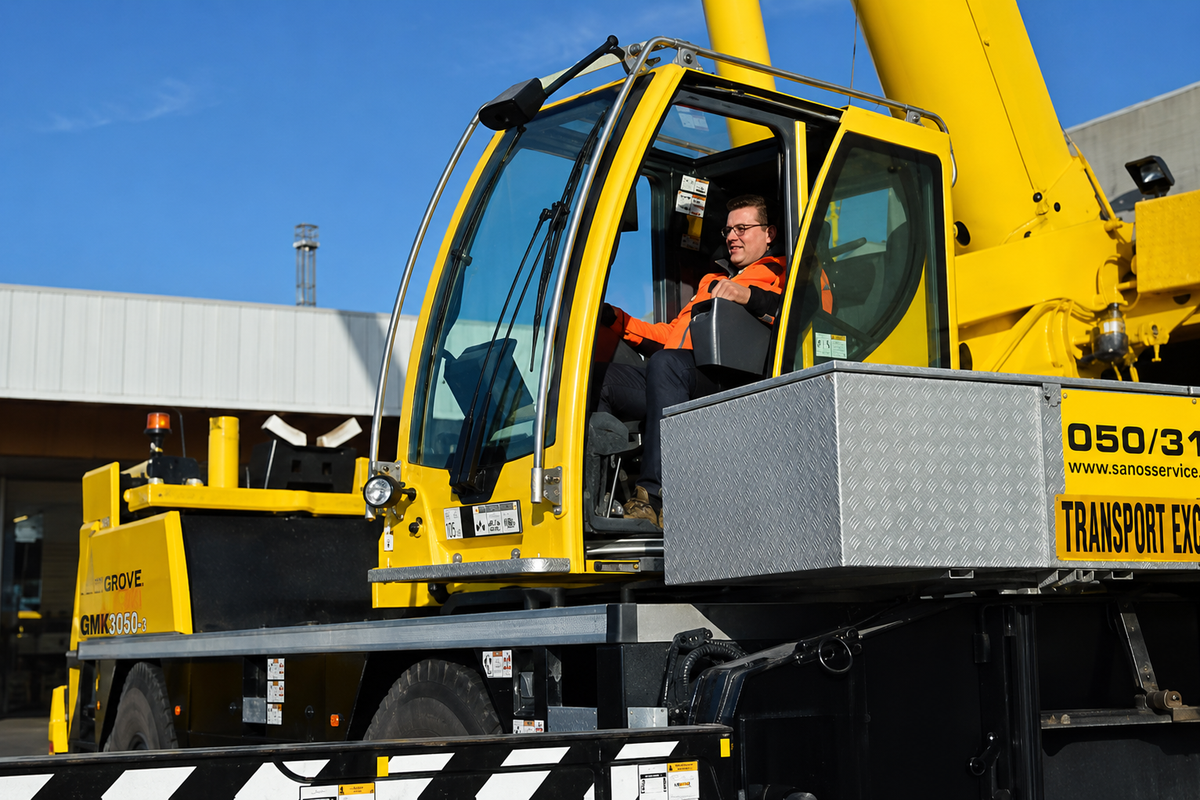
Legally required mobile crane certificate in the Netherlands
WHAT DOES THIS MOBILE CRANE OPERATOR TCVT W4-01 TRAINING COVER?
The T.C.V.T. certificate of professional competence under certification scheme W4-01 is legally required.
Every operator who, in the Netherlands, operates a crane on a construction site and/or erects a structure must hold a TCVT certificate.
This training follows the mobile crane certification scheme of the Toezicht Certificatie Verticaal Transport (T.C.V.T.) foundation.
The 'Mobile Crane Operator' training covers all work permitted by the manufacturer and legislation with mobile cranes over 10 tonnes/metre and prepares the participant for the ISO 17024 exam.
This training addresses not only setting up, but also modifying and operating the crane, stability and load capacity and, of course, the technical systems.
In addition, there is of course also instruction in working with approved lifting gear and an approved mobile crane.
Practice shows that incorrect use of the crane and lifting gear entails major risks.
The training is given by experienced and well-trained instructors who all also have long experience as crane operators. An approved 35-tonne mobile crane is used.
Target group and admission requirements
- People who work as an operator on a mobile crane are trained for the T.C.V.T. certificate of professional competence 'Mobile Crane Operator'
- No limitations of sight, hearing functions and motor skills
- Required to wear a helmet, gloves and class S3 safety shoes during the practical part of the training
- Participants are expected to also spend time on home study and homework assignments during the training period for the theory part
Theory
- Legal requirements
- Crane and personal documents
- Technology
- Safety
- Work preparation and communication
- Lifting means and lifting gear
- Loading and unloading
- Lifting and slinging loads
Practice
- Checking the mobile crane
- Safety measures
- Independently operating and moving the crane
- Modifying the crane's jib system
- Drawing up a simple lifting plan
- Loading and unloading
- Lifting and slinging loads
- Recognising faults and taking action
- Packing up and preparing for transport
- Aftercare and environmentally responsible working
NO WORDS, BUT ACTIONS
- The training includes an exam administered by V-TAS B.V., under the supervision and responsibility of T.U.V.
- The exam consists of a practical and a theory exam and takes place on the last day of training
- If the exam is passed successfully, the participant receives a T.C.V.T. certificate and practice register valid for 5 years
- The basis of the legally required certification schemes managed by TCVT lies in the Working Conditions Act (Arbeidsomstandighedenwet) and the Commodities Act (Warenwet).
- Operators who work on a construction site with a lifting crane with a maximum load moment of 10 tm or more must hold a valid TCVT certificate.
- This concerns lifting with the following machines:
- mobile lifting crane
- loader crane (does not apply to loading and unloading the vehicle beside the vehicle)
- earth-moving machine (does not apply to lifting pipelines)
- telehandler
- mobile tower crane
- tower crane
- foundation machine (large + small: the limit is 30 tonnes)
Frequently asked questions
For whom is the TCVT W4-01 certificate mandatory?
For every operator working in the Netherlands on a construction site with a crane with a load moment of 10 tm or more.
How long is the certificate valid?
The T.C.V.T. certificate and practice register are valid for 5 years.
How does the exam work?
The exam consists of a practical and a theory exam, administered by V-TAS B.V. under the supervision of T.U.V. on the last day of training.