
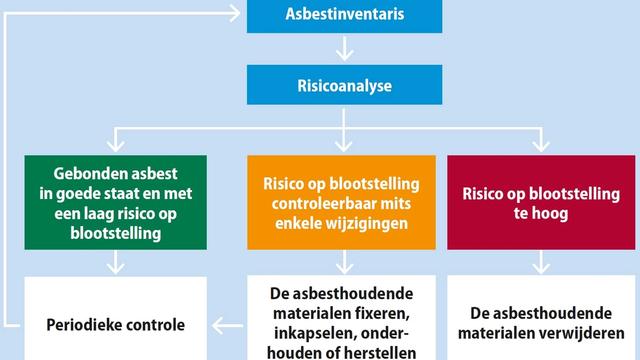
During 2022, it is mandatory to provide the owner with an asbestos certificate when selling a construction built before 2001. The asbestos certificate or asbestos inspection can only be drawn up by a recognised asbestos expert.
Mandatory actions during the site visit for the asbestos inventory
The mandatory actions for drawing up an asbestos inventory are the physical actions that the asbestos expert must and is legally required to carry out during the on-site inspection for drawing up an asbestos inventory certificate. The mandatory actions aim to inventory the inspectable materials and concern actions:
- that can be carried out without investigation restriction;
- in which no material is dismantled or damaged, with the exception of:
- removing a piece of paint, coating, wallpaper, plastic or textile to inspect an underlying asbestos-suspected material or to take a sample;
- damaging asbestos-suspected materials for sampling if no risk of damage remains for the normal use of the building.
If the owner voluntarily gave the order for additional investigation via the assignment form, more actions will be needed than the mandatory actions mentioned here.
Materials to be inspected for the asbestos inventory
In principle, the materials to be inspected are all asbestos-suspected materials in the inspection area, whether or not they fall under the concept 'easily accessible'. The circumstances on site during the asbestos inventory determine whether the materials to be inspected are actually inspectable in practice or not. We therefore make a distinction between inspectable and non-inspectable materials.
The inspectable materials are asbestos-suspected materials of which identification and risk assessment are possible on the basis of the best-efforts obligations or on the basis of visual observation and expertise.
Identification (determining whether it contains asbestos or not) of a material can only be done via:
- visual observation and expertise;
- supporting documents + confirmation via visual observation and expertise;
- laboratory analysis by a recognised asbestos laboratory.
Non-inspectable materials for the asbestos inventory
If a full identification of an asbestos-suspected material is not possible, but a further full risk assessment is possible, the asbestos expert uses a source sheet. If neither full identification nor full risk assessment is possible, the expert uses the limitation sheet.
Non-inspectable materials are asbestos-suspected materials of which no identification and no risk assessment are possible on the basis of the best-efforts obligations or on the basis of visual observation and expertise.
For non-inspectable materials, the asbestos expert nevertheless reports asbestos-suspected materials or their presumed presence via an advice sheet. There are three possibilities here:
- reasonable presumption: on the basis of expertise and experience, the asbestos expert can report the presumed presence of an asbestos-containing material;
- supporting documents: a supporting document may mention an asbestos-containing material that is, however, not (sufficiently) inspectable;
- accepted literature studies: e.g. weathering residues of asbestos-cement roof and façade cladding.
Having an asbestos certificate drawn up
To obtain an asbestos certificate, a non-destructive investigation is sufficient with a view to normal use of the home or construction.
Every owner can voluntarily ask the asbestos expert to carry out additional investigation. These are investigation efforts that are not required by default to obtain an asbestos certificate and that the asbestos expert will therefore not carry out by default. The expert is responsible for the correct content of this additional investigation and its correct entry into OVAM's database.
Non-destructive investigation
The asbestos expert by default carries out a non-destructive investigation in accordance with the best-efforts obligations described in the inspection protocol. A non-destructive asbestos inventory is sufficient to obtain an asbestos certificate. The owner can request the asbestos expert to also proceed destructively for all or parts of a property, for example with a view to future work.
Destructive investigation
A destructive investigation is carried out during large-scale repair, renovation or demolition work, in which enclosed materials may be damaged or exposed. For work that gives rise to exposure to asbestos, the client supplements the asbestos inventory with:
- information about the presence of asbestos in hard-to-reach parts that do not give rise to asbestos under normal conditions
- Intact material that is not touched under normal conditions may be damaged by sampling for this inventory