
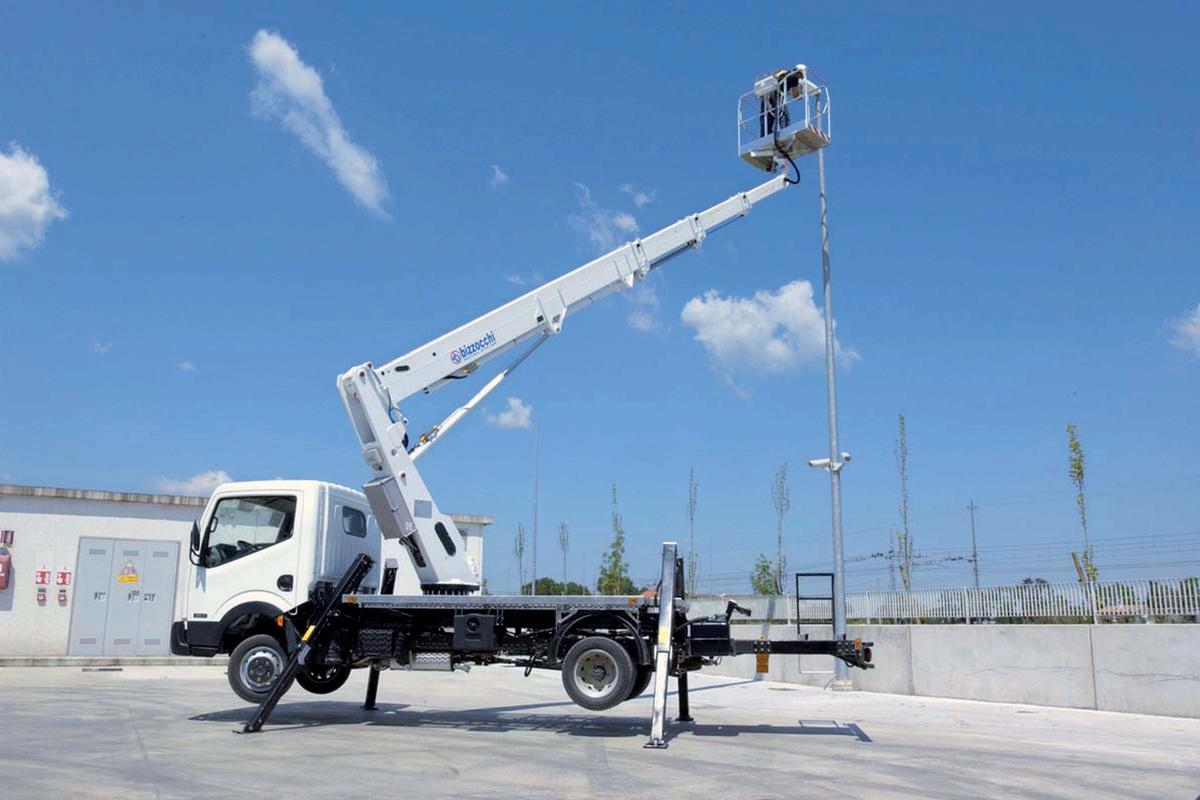
Obtain your IS-004 truck-mounted aerial platform diploma now!
WHAT CAN YOU EXPECT FROM THIS IS-004 TRUCK-MOUNTED AERIAL PLATFORM TRAINING?
For the IS-004 truck-mounted aerial platform diploma you've come to the right place at Normec Praxis!
The IS diplomas are essential in the petrochemical industry and port companies.
The training can take place at your location or in one of our partner centres in Flanders.
The number of training days depends on your experience and competencies.
If you pass, you receive the official IS-004 diploma!
If your sector or client does not require this specific diploma, then follow our standard truck-mounted aerial platform training or truck-mounted aerial platform competency test.
The goal of this training is to effectively and safely work with the truck-mounted aerial platform werken.
ADMISSION REQUIREMENTS
- Experienced or not? Every operator of a truck-mounted aerial platform is welcome in this training!
- Be at least 18 years old
- Identification possible by means of an identity card, passport or driving licence
- Have a certificate of medical fitness
- The participant masters the language of the exams
- Normec Praxis pursues an active equal-opportunities policy. Our exams are open to everyone who meets the conditions, regardless of their gender, skin colour or religion
- Have no fear of heights
- Exam regulations available on request for in-company trainings
TARGET GROUP
Employees who have to work with a truck-mounted aerial platform on a (petro)chemical company site in installations, workshops or laboratories.
For employees who work in the (petro)chemical industry, this exam must be taken in an accredited centre.
GOAL
Learn to work safely and efficiently with a truck-mounted aerial platform.
- Holding a safety function
- Operate the device efficiently
- Be able to report defects and malfunctions preventively
- Prevent accidents and injuries
- Prevent damage to products and reduce damage caused by transport
- Work safely and dynamically
NO WORDS, BUT DEEDS!
- A full day of training lasts 7 hours by default, unless otherwise stated
- One or more days of tailored practical training
- A lot of experience (1 day) / little experience (2 days) / no experience (3 to 5 days)
- Theory exam + practical exam
- Every successful participant receives the official TRUCK-MOUNTED AERIAL PLATFORM certificate
- The certificate is valid for 5 years and is registered in the Normec Praxis certificate portal
- Every successful participant receives the Besacc-VCA diploma IS-004: working with a truck-mounted aerial platform
- The diploma is personal and states the high-risk task for which the participant has passed
- The diploma is valid for 5 years and is registered online at http://besacc.epyc.eu/diploma
THEORY ASSESSMENT CRITERIA
- Know that different types of truck-mounted aerial platforms exist and what their limitations are
- Know the safety regulations
- Know the basic legislation for an operator of aerial platforms
- Know that the devices must be inspected as lifting equipment
- Know important concepts regarding the control devices
- Knowledge of the structure of the telescopic arm
- Knowledge regarding stability rules
- Influence of wind on the aerial platform
- Know the elements that make up the start-up check
- Know which checks and actions to carry out at the end of the work
PRACTICAL ASSESSMENT CRITERIA
- Be able to correctly carry out the daily inspection, recognise dangerous defects, and report them
- Check the inspection documents
- Apply the safety rules
- Learn to use a safety harness correctly
- Operate the emergency descent system
- Be able to use the control devices correctly
- Manoeuvres
- Turning behaviour and approaching an object at height
- Extending to maximum reach
- Use the telescopic arm correctly
- Be able to estimate distances, depth and height
- Apply order and cleanliness
- Be able to set up the device safely and make good use of outriggers and outrigger pads
- The use of the emergency control
- Manoeuvre in a controlled manner, raise the platform to maximum height, lower the platform to rest position
- Set the correct transport position of the truck
OTHER HIGH-RISK TASKS
We also organise exams for the following high-risk tasks:
- IS-001 - Working with a forklift advanced
- IS-002 - Working with a reach truck advanced
- IS-003 - Working with a rigid telehandler
- IS-004 - Working with a truck-mounted aerial platform
- IS-005 - Working with a self-propelled aerial platform
- IS-006 - Slinging and directing critical loads
- IS-007 - Safety watch confined space
- IS-009 - Working with personal fall protection advanced
- IS-010 - Working on flanges - flange fitter
- IS-011 - Working with an overhead crane with cable control / remote control
- IS-012 - Working with an overhead crane with cabin control
- IS-013 - Measuring and detecting hazardous substances (EX-OX-TOX)
- IS-031 - Working with a rotating telehandler
- IS-032 - Working with a rotating telehandler with lifting function
- IS-081 - Working with independent (autonomous and non-autonomous) respiratory protection
- IS-082 - Working with independent non-autonomous respiratory protection
- AV-001 - Working with a forklift truck basic
- AV-002 - Working with a reach truck basic
- AV-003 - Working with a scissor lift
- AV-004 - Slinging and directing non-critical loads
- AV-006 - Working with personal fall protection basic
- AV-011 - Fire watch (including: Extinguishing with small extinguishing means (AV-012))
- AV-012 - Extinguishing with small extinguishing means
- AV-013 - Working with a mobile crane
- AV-014 - Working with an earthmoving machine with lifting function
- AV-015 - Working with a truck loader crane
- AV-016 - Working with a self-erecting crane up to 10 tonne-metres
- AV-017 - Working with a tower crane
- AV-021 - Scaffolder
- AV-022 - Scaffolding inspector
WHAT DOES THE LAW SAY?
Mobile work equipment with their own propulsion may only be operated by workers who have received adequate training for the safe operation of this work equipment (Codex book IV, title 3)
Regarded as a safety function is every workstation where work equipment is used, where motor vehicles, cranes, overhead cranes, hoisting devices of any kind are operated (Codex book I, title 4)